
DESCRIPTION:
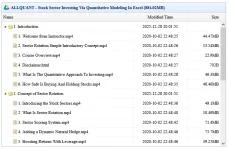
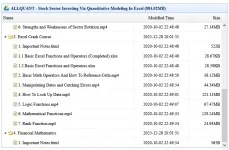
This program institutionalizes sector rotation strategies—practiced by hedge funds—into an Excel-based system with integrated dynamic hedging. Participants construct a model that systematically selects outperforming equity sectors using momentum-based scoring while simultaneously deploying a volatility hedge to mitigate drawdowns during broad market declines. The curriculum delivers a defensive equity strategy requiring five minutes of daily operation, eliminating dependency on fundamental research or market timing discretion.
Core Value Proposition: Build a quantitative sector selection engine that captures sector-level alpha while maintaining portfolio-level risk comparable to broad market exposure, using only free data sources and Excel.
LEARNING OBJECTIVES
Upon completion, participants will demonstrate competency in:
Sector Rotation Mechanics: Momentum-based ranking of sector ETFs using relative strength metrics
Quantitative Investing Framework: Systematic, data-driven approach versus discretionary sector picking
Dynamic Hedging: Integrating VIX-based or bond-based hedges to offset equity downside
Excel Implementation: VLOOKUP, INDEX/MATCH, array formulas, and percentile ranking functions
Rebalancing Systems: Weekly versus monthly sector rotation frequency optimization
Transaction Cost Integration: Modeling ETF expense ratios and commission drag on high-turnover strategies
Performance Metrics: Computing Sharpe ratio, Sortino ratio, and hedge efficiency metrics
VBA Automation: Scripting data updates and weight optimization to minimize manual intervention
Sector Universe Construction: Selecting liquid, low-correlation sector ETFs (XLF, XLU, XLY, XLV, etc.)
COURSE CONTENT STRUCTURE
Total Duration: Approximately 8 hours across 7 sections
SECTION 1: INTRODUCTION (30 minutes)Limitations of buy-and-hold and market-cap-weighted indices
Sector rotation rationale: dispersion creates alpha opportunities
Course roadmap and performance expectations
SECTION 2: CONCEPT OF SECTOR ROTATION (90 minutes)Empirical evidence: sector momentum persistence at 3-6 month horizons
Sector classification: GICS framework and liquid ETF mapping (XLF, XLU, XLY, XLV, XLI, XLB, XLP, XLE)
Relative strength ranking: price momentum, volatility-adjusted returns, risk parity sector weighting
Dynamic hedging: VIX futures-based ETFs (VXX) or long-duration treasuries (TLT) as portfolio hedge
Strategy weaknesses: sector concentration risk, regime shifts (e.g., 2020 COVID rotation), tax inefficiency from high turnover
SECTION 3: EXCEL CRASH COURSE (60 minutes)Critical functions: VLOOKUP, INDEX/MATCH, array formulas, conditional logic, percentile ranking
Data structuring for weekly sector price series
VBA fundamentals: recording macros for data refresh automation
Error checking: handling missing data and corporate actions
SECTION 4: FINANCIAL MATHEMATICS (90 minutes)Arithmetic and logarithmic returns for momentum calculation
Rolling returns: 4-week, 12-week, 24-week ranking periods
Volatility estimation: annualized standard deviation for risk adjustment
Sharpe ratio: computing risk-adjusted sector performance
Hedge ratio calculation: sizing VXX/TLT position based on portfolio beta
Transaction cost impact: modeling 0.10% commissions and 0.03% bid-ask spreads
SECTION 5: BUILDING THE SECTOR ROTATION MODEL (180 minutes)Data acquisition: Yahoo Finance bulk download for nine sector ETFs
Scoring system: combining 12-week returns (50%), volatility-adjusted returns (30%), and 4-week momentum (20%)
Ranking engine: dynamic sorting and selecting top 3-4 sectors
Hedge integration: VXX position scaled by VIX percentile (e.g., 20% allocation when VIX < 20, 30% when VIX > 30)
Position sizing: equal-weight versus risk-parity weight across selected sectors
Rebalancing logic: weekly rotation with 5% turnover threshold to minimize costs
Backtesting engine: vectorized simulation with transaction cost drag
SECTION 6: OPERATING THE SECTOR ROTATION MODEL (30 minutes)Daily workflow: 5-minute data update and signal verification protocol
Weekly rotation: executing sector switches and hedge adjustments
Risk monitoring: sector concentration limits (max 30% per sector), correlation drift
Performance logging: separating sector alpha from hedge payoffs
Crisis protocol: temporarily rotating to defensive sectors (XLU, XLP) and increasing hedge when VIX > 40
SECTION 7: BONUS: VBA SCRIPTS (30 minutes)Automated data refresh: button-click update for nine sector ETFs and VIX
Scoring automation: macro to compute rankings and generate trade list
Hedge sizing: VBA to calculate VXX/TLT allocation based on VIX percentile
DELIVERABLES & RESOURCES
Fully Completed Model File: Live-ready Excel workbook with sector scoring engine, ranking system, and dynamic hedge calculator
VBA Automation Scripts: Pre-written macros for daily data refresh and weekly ranking calculations
Guided Build Templates: Step-by-step worksheets for progressive model construction
Practice Exercises: Sector rotation mathematics and hedge ratio problem sets with solutions
Performance Analytics Worksheet: Pre-built metrics calculator for Sharpe ratio, sector attribution, and hedge efficiency
Decision Dashboard: Interactive interface showing current rankings, selected sectors, hedge allocation, and rebalancing alerts
TARGET AUDIENCE PROFILE
Optimal Fit:Equity portfolio managers seeking systematic sector alpha without stock picking
Investment advisors managing ₹25+ lakh client portfolios requiring sector diversification
Sophisticated self-directed investors wanting to outperform broad indices while controlling downside
Quantitative analysts building tactical asset allocation overlays for asset management firms
Proprietary traders rotating capital across sector themes systematically
Suboptimal Fit:Individuals seeking buy-and-hold simplicity (strategy requires weekly rebalancing)
Participants uncomfortable with high portfolio turnover (annual turnover 300-400%)
Investors without intermediate Excel proficiency (ranking engine debugging is complex)
Traders requiring intraday signals (strategy operates on weekly rotation frequency)
Those in taxable jurisdictions without regard for short-term capital gains (strategy triggers frequent STCG)
PREREQUISITES & TECHNICAL REQUIREMENTS
Intellectual Prerequisites:Equity market mechanics: understanding of sectors, ETFs, and market-cap weighting
Statistics: percentile ranks, correlation, rolling returns
Portfolio theory: basic appreciation of diversification and hedging concepts
Derivatives basics: VIX futures and volatility ETF mechanics (for hedge module)
Technical Prerequisites:Microsoft Excel 2016 or later with VBA macros enabled
Stable internet connection for daily data retrieval across 10+ instruments
No prior VBA or programming knowledge required
Software Provision: All analysis uses free Yahoo Finance data; no mandatory data vendor subscriptions
INSTRUCTOR BIOGRAPHIES
ENG GUAN – CO-FOUNDER & LEAD INSTRUCTOR
Quantitative investment practitioner with 15+ years spanning sovereign wealth funds, investment banks, proprietary trading desks, and multi-strategy hedge funds. Most recent role: key Portfolio Manager at a Singapore-based multi-strategy hedge fund, managing cross-asset systematic strategies with direct P&L responsibility. Holds MSc in Financial Engineering specializing in derivatives pricing and optimal execution algorithms.
Pedagogical Edge: Direct hedge fund implementation experience ensures instruction reflects operational realities: transaction cost management, liquidity constraints, and institutional risk mandates. Sovereign wealth fund background provides long-horizon perspective on sector rotation persistence.
PATRICK LING – CO-FOUNDER & SENIOR INSTRUCTOR
15+ years comprehensive investment industry experience across private banking (UBS), investment banking (Goldman Sachs), and hedge fund portfolio management. As a key Portfolio Manager at the same Singapore-based multi-strategy hedge fund, he co-managed systematic equity strategies and developed proprietary risk analytics. Holds MSc in Wealth Management integrating quantitative techniques with high-net-worth client portfolio construction.
Pedagogical Edge: Private banking experience translates quantitative sector rotation into executable processes for non-institutional investors. Hedge fund tenure provides insight into combining sector momentum with volatility hedging—critical context for preventing single-strategy failure.
Joint Credibility: Both instructors maintain parallel practitioner careers, ensuring curriculum evolves with current industry standards rather than academic abstraction.
METHODOLOGICAL APPROACH
The course employs a "build-operate-stress test" framework. Participants construct the sector rotation model, operate it through four regimes (bull market, bear market, high volatility, low volatility), then stress-test hedge effectiveness during correlation breakdowns. Each module includes failure-mode analysis: what happens when momentum fails (whipsaw), when hedge fails to offset losses, and when all sectors drop simultaneously.
Instruction emphasizes ranking methodology robustness over return prediction, teaching participants to think in terms of relative strength persistence rather than absolute sector calls.
Time Commitment: Video instruction totals 8 hours; practical implementation requires estimated additional 4-6 hours for independent model building and parameter calibration. Five-minute daily operation assumes stable model and reliable data feeds.
STRATEGY SCOPE & LIMITATIONS
Geographic Application: Explicit model calibrated for U.S. sector ETFs (SPDR sector series: XLF, XLU, XLY, XLV, XLI, XLB, XLP, XLE plus VXX hedge). Mathematical architecture is transferable to Indian markets (Nifty sector indices, sectoral ETFs) where liquid instruments exist.
Capacity Considerations: Sector rotation strategy requires minimum capital of ₹15 lakh for effective implementation across 3-4 sectors plus hedge while keeping transaction costs below 0.15% annually.
Performance Expectations: Model targets 12-14% annual returns with 18-20% volatility (Sharpe ratio ≈ 0.6-0.7), outperforming S&P 500 by 2-3% annually while matching its volatility. The dynamic hedge reduces maximum drawdown from -50% to -35% during 2008/2020-style crashes.
Key Limitations:
High turnover: Weekly rebalancing triggers significant short-term capital gains; after-tax edge may disappear in high-tax jurisdictions
Regime dependency: Momentum fails during rapid sector rotations (e.g., March 2020 COVID rotation from cyclicals to defensives)
ETF tracking error: Sector ETFs exhibit 0.05-0.10% annual tracking error versus indices
Hedge cost: VIX-based hedge incurs contango decay of 5-10% annually during calm markets, creating performance drag
BOTTOM-LINE ASSESSMENT
This program provides precise, practitioner-validated sector rotation infrastructure with integrated hedging, built entirely in Excel. The instructors' hedge fund experience ensures the model addresses real-world frictions: transaction costs, sector liquidity constraints, and hedge efficiency decay during volatile periods.
Critical Differentiator: Unlike academic momentum courses, this explicitly teaches dynamic hedging integration—a non-optional component for non-institutional investors who cannot tolerate 50% drawdowns during sector rotation failures.
For portfolio managers, investment advisors, and sophisticated HNW investors seeking systematic sector alpha with downside protection, this represents the most complete Excel-based implementation of hedge fund sector rotation principles without programming requirements. The primary risk is tax inefficiency: weekly turnover generates significant STCG that can erode 1-2% of annual edge. Participants should implement in tax-advantaged accounts where possible.
SOURCE: purchase from a reseller
Original seller site:
https://www.allquant.co/
This program institutionalizes sector rotation strategies—practiced by hedge funds—into an Excel-based system with integrated dynamic hedging. Participants construct a model that systematically selects outperforming equity sectors using momentum-based scoring while simultaneously deploying a volatility hedge to mitigate drawdowns during broad market declines. The curriculum delivers a defensive equity strategy requiring five minutes of daily operation, eliminating dependency on fundamental research or market timing discretion.
Core Value Proposition: Build a quantitative sector selection engine that captures sector-level alpha while maintaining portfolio-level risk comparable to broad market exposure, using only free data sources and Excel.
LEARNING OBJECTIVES
Upon completion, participants will demonstrate competency in:
Sector Rotation Mechanics: Momentum-based ranking of sector ETFs using relative strength metrics
Quantitative Investing Framework: Systematic, data-driven approach versus discretionary sector picking
Dynamic Hedging: Integrating VIX-based or bond-based hedges to offset equity downside
Excel Implementation: VLOOKUP, INDEX/MATCH, array formulas, and percentile ranking functions
Rebalancing Systems: Weekly versus monthly sector rotation frequency optimization
Transaction Cost Integration: Modeling ETF expense ratios and commission drag on high-turnover strategies
Performance Metrics: Computing Sharpe ratio, Sortino ratio, and hedge efficiency metrics
VBA Automation: Scripting data updates and weight optimization to minimize manual intervention
Sector Universe Construction: Selecting liquid, low-correlation sector ETFs (XLF, XLU, XLY, XLV, etc.)
COURSE CONTENT STRUCTURE
Total Duration: Approximately 8 hours across 7 sections
SECTION 1: INTRODUCTION (30 minutes)Limitations of buy-and-hold and market-cap-weighted indices
Sector rotation rationale: dispersion creates alpha opportunities
Course roadmap and performance expectations
SECTION 2: CONCEPT OF SECTOR ROTATION (90 minutes)Empirical evidence: sector momentum persistence at 3-6 month horizons
Sector classification: GICS framework and liquid ETF mapping (XLF, XLU, XLY, XLV, XLI, XLB, XLP, XLE)
Relative strength ranking: price momentum, volatility-adjusted returns, risk parity sector weighting
Dynamic hedging: VIX futures-based ETFs (VXX) or long-duration treasuries (TLT) as portfolio hedge
Strategy weaknesses: sector concentration risk, regime shifts (e.g., 2020 COVID rotation), tax inefficiency from high turnover
SECTION 3: EXCEL CRASH COURSE (60 minutes)Critical functions: VLOOKUP, INDEX/MATCH, array formulas, conditional logic, percentile ranking
Data structuring for weekly sector price series
VBA fundamentals: recording macros for data refresh automation
Error checking: handling missing data and corporate actions
SECTION 4: FINANCIAL MATHEMATICS (90 minutes)Arithmetic and logarithmic returns for momentum calculation
Rolling returns: 4-week, 12-week, 24-week ranking periods
Volatility estimation: annualized standard deviation for risk adjustment
Sharpe ratio: computing risk-adjusted sector performance
Hedge ratio calculation: sizing VXX/TLT position based on portfolio beta
Transaction cost impact: modeling 0.10% commissions and 0.03% bid-ask spreads
SECTION 5: BUILDING THE SECTOR ROTATION MODEL (180 minutes)Data acquisition: Yahoo Finance bulk download for nine sector ETFs
Scoring system: combining 12-week returns (50%), volatility-adjusted returns (30%), and 4-week momentum (20%)
Ranking engine: dynamic sorting and selecting top 3-4 sectors
Hedge integration: VXX position scaled by VIX percentile (e.g., 20% allocation when VIX < 20, 30% when VIX > 30)
Position sizing: equal-weight versus risk-parity weight across selected sectors
Rebalancing logic: weekly rotation with 5% turnover threshold to minimize costs
Backtesting engine: vectorized simulation with transaction cost drag
SECTION 6: OPERATING THE SECTOR ROTATION MODEL (30 minutes)Daily workflow: 5-minute data update and signal verification protocol
Weekly rotation: executing sector switches and hedge adjustments
Risk monitoring: sector concentration limits (max 30% per sector), correlation drift
Performance logging: separating sector alpha from hedge payoffs
Crisis protocol: temporarily rotating to defensive sectors (XLU, XLP) and increasing hedge when VIX > 40
SECTION 7: BONUS: VBA SCRIPTS (30 minutes)Automated data refresh: button-click update for nine sector ETFs and VIX
Scoring automation: macro to compute rankings and generate trade list
Hedge sizing: VBA to calculate VXX/TLT allocation based on VIX percentile
DELIVERABLES & RESOURCES
Fully Completed Model File: Live-ready Excel workbook with sector scoring engine, ranking system, and dynamic hedge calculator
VBA Automation Scripts: Pre-written macros for daily data refresh and weekly ranking calculations
Guided Build Templates: Step-by-step worksheets for progressive model construction
Practice Exercises: Sector rotation mathematics and hedge ratio problem sets with solutions
Performance Analytics Worksheet: Pre-built metrics calculator for Sharpe ratio, sector attribution, and hedge efficiency
Decision Dashboard: Interactive interface showing current rankings, selected sectors, hedge allocation, and rebalancing alerts
TARGET AUDIENCE PROFILE
Optimal Fit:Equity portfolio managers seeking systematic sector alpha without stock picking
Investment advisors managing ₹25+ lakh client portfolios requiring sector diversification
Sophisticated self-directed investors wanting to outperform broad indices while controlling downside
Quantitative analysts building tactical asset allocation overlays for asset management firms
Proprietary traders rotating capital across sector themes systematically
Suboptimal Fit:Individuals seeking buy-and-hold simplicity (strategy requires weekly rebalancing)
Participants uncomfortable with high portfolio turnover (annual turnover 300-400%)
Investors without intermediate Excel proficiency (ranking engine debugging is complex)
Traders requiring intraday signals (strategy operates on weekly rotation frequency)
Those in taxable jurisdictions without regard for short-term capital gains (strategy triggers frequent STCG)
PREREQUISITES & TECHNICAL REQUIREMENTS
Intellectual Prerequisites:Equity market mechanics: understanding of sectors, ETFs, and market-cap weighting
Statistics: percentile ranks, correlation, rolling returns
Portfolio theory: basic appreciation of diversification and hedging concepts
Derivatives basics: VIX futures and volatility ETF mechanics (for hedge module)
Technical Prerequisites:Microsoft Excel 2016 or later with VBA macros enabled
Stable internet connection for daily data retrieval across 10+ instruments
No prior VBA or programming knowledge required
Software Provision: All analysis uses free Yahoo Finance data; no mandatory data vendor subscriptions
INSTRUCTOR BIOGRAPHIES
ENG GUAN – CO-FOUNDER & LEAD INSTRUCTOR
Quantitative investment practitioner with 15+ years spanning sovereign wealth funds, investment banks, proprietary trading desks, and multi-strategy hedge funds. Most recent role: key Portfolio Manager at a Singapore-based multi-strategy hedge fund, managing cross-asset systematic strategies with direct P&L responsibility. Holds MSc in Financial Engineering specializing in derivatives pricing and optimal execution algorithms.
Pedagogical Edge: Direct hedge fund implementation experience ensures instruction reflects operational realities: transaction cost management, liquidity constraints, and institutional risk mandates. Sovereign wealth fund background provides long-horizon perspective on sector rotation persistence.
PATRICK LING – CO-FOUNDER & SENIOR INSTRUCTOR
15+ years comprehensive investment industry experience across private banking (UBS), investment banking (Goldman Sachs), and hedge fund portfolio management. As a key Portfolio Manager at the same Singapore-based multi-strategy hedge fund, he co-managed systematic equity strategies and developed proprietary risk analytics. Holds MSc in Wealth Management integrating quantitative techniques with high-net-worth client portfolio construction.
Pedagogical Edge: Private banking experience translates quantitative sector rotation into executable processes for non-institutional investors. Hedge fund tenure provides insight into combining sector momentum with volatility hedging—critical context for preventing single-strategy failure.
Joint Credibility: Both instructors maintain parallel practitioner careers, ensuring curriculum evolves with current industry standards rather than academic abstraction.
METHODOLOGICAL APPROACH
The course employs a "build-operate-stress test" framework. Participants construct the sector rotation model, operate it through four regimes (bull market, bear market, high volatility, low volatility), then stress-test hedge effectiveness during correlation breakdowns. Each module includes failure-mode analysis: what happens when momentum fails (whipsaw), when hedge fails to offset losses, and when all sectors drop simultaneously.
Instruction emphasizes ranking methodology robustness over return prediction, teaching participants to think in terms of relative strength persistence rather than absolute sector calls.
Time Commitment: Video instruction totals 8 hours; practical implementation requires estimated additional 4-6 hours for independent model building and parameter calibration. Five-minute daily operation assumes stable model and reliable data feeds.
STRATEGY SCOPE & LIMITATIONS
Geographic Application: Explicit model calibrated for U.S. sector ETFs (SPDR sector series: XLF, XLU, XLY, XLV, XLI, XLB, XLP, XLE plus VXX hedge). Mathematical architecture is transferable to Indian markets (Nifty sector indices, sectoral ETFs) where liquid instruments exist.
Capacity Considerations: Sector rotation strategy requires minimum capital of ₹15 lakh for effective implementation across 3-4 sectors plus hedge while keeping transaction costs below 0.15% annually.
Performance Expectations: Model targets 12-14% annual returns with 18-20% volatility (Sharpe ratio ≈ 0.6-0.7), outperforming S&P 500 by 2-3% annually while matching its volatility. The dynamic hedge reduces maximum drawdown from -50% to -35% during 2008/2020-style crashes.
Key Limitations:
High turnover: Weekly rebalancing triggers significant short-term capital gains; after-tax edge may disappear in high-tax jurisdictions
Regime dependency: Momentum fails during rapid sector rotations (e.g., March 2020 COVID rotation from cyclicals to defensives)
ETF tracking error: Sector ETFs exhibit 0.05-0.10% annual tracking error versus indices
Hedge cost: VIX-based hedge incurs contango decay of 5-10% annually during calm markets, creating performance drag
BOTTOM-LINE ASSESSMENT
This program provides precise, practitioner-validated sector rotation infrastructure with integrated hedging, built entirely in Excel. The instructors' hedge fund experience ensures the model addresses real-world frictions: transaction costs, sector liquidity constraints, and hedge efficiency decay during volatile periods.
Critical Differentiator: Unlike academic momentum courses, this explicitly teaches dynamic hedging integration—a non-optional component for non-institutional investors who cannot tolerate 50% drawdowns during sector rotation failures.
For portfolio managers, investment advisors, and sophisticated HNW investors seeking systematic sector alpha with downside protection, this represents the most complete Excel-based implementation of hedge fund sector rotation principles without programming requirements. The primary risk is tax inefficiency: weekly turnover generates significant STCG that can erode 1-2% of annual edge. Participants should implement in tax-advantaged accounts where possible.
SOURCE: purchase from a reseller
Original seller site:
https://www.allquant.co/